
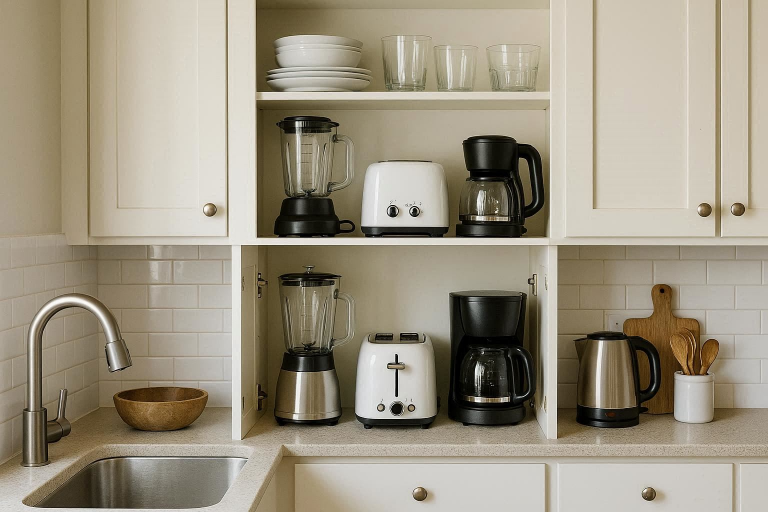
Every home cook knows the struggle: you start with a clean, open kitchen counter, and slowly, it gets swallowed by a jungle of gadgets. The blender, the Instant Pot, the air fryer, the stand mixer—they’re all invaluable tools, yet together, they create a chaotic scene.
If your countertop is more of an appliance parking lot than a prep space, it’s time for a strategic overhaul. Learning how to store small kitchen appliances is the secret to a more functional, efficient, and beautiful cooking area.
This isn’t just about hiding things. It’s about designing a system that ensures the right tool is always in the right place, accessible and ready for action.
Let’s dive into the strategies and solutions that will revolutionize your kitchen organization.
The Foundation: A 3-Step Decluttering & Categorization Process
Before you invest in any new storage solution, you must first know what you are storing. A disorganized storage spot is just a hidden mess.
Start by tackling the three foundational steps of appliance organization.
Step 1: Gather and Purge Ruthlessly
First, pull every single small appliance, gadget, and accessory out of your cabinets, pantry, and off your countertops. Seeing the full collection in Store Kitchen Appliances one place is often the most motivating (and alarming) part of the process.
Now, be honest with yourself about their value. Ask these three questions:
-
When did I last use this? If the answer is “more than a year ago,” it’s a strong candidate for donation or selling.
-
Is it broken or missing parts? Get rid of it, or find the replacement part now.
-
Do I have a duplicate or a better version? For instance, does your food processor make your blender obsolete for certain tasks?
💡 Pro Tip: If you’re struggling to part with an item, use the ‘Box Method.’ Place it in a labeled box and store it in a non-kitchen area (like a closet or garage) for 6 months. If you never need it, donate the entire box.
Step 2: Group Appliances by Frequency of Use (The Core Strategy)
The single most important rule in appliance storage is to store items where they are used and according to how often you need them. This principle guides where each item earns its parking spot.
Daily Use (Countertop or Quick Access)
These are the indispensable items you reach for every single day. They have earned their spot on the counter or in the very front of the most accessible cabinet.
-
Examples: Coffee maker, electric kettle, toaster/toaster oven, air fryer (for some).
Weekly/Monthly Use (Cabinets and Pantries)
These are the workhorse appliances. They need to be stored in Kitchen Appliances for Small Homes the kitchen but should not clutter the prime prep space. They belong in an easy-to-reach cabinet, a deep drawer, or the lower shelves of a pantry.
-
Examples: Blender, food processor, stand mixer, hand mixer, slow cooker/Instant Pot.
Rarely Used (Overflow/Long-Term Storage)
These appliances only come out for special occasions, specific seasons, or very specific tasks. They do not deserve valuable, prime kitchen real estate. Store them in a nearby closet, the basement, or the garage.
-
Examples: Ice cream maker, waffle maker, bread machine, specialty juicer, large carving knife set.
Step 3: Prepare Appliances for Storage
A major source of clutter is unruly cords. Before tucking any appliance away, ensure it is clean and its parts are secure.
-
Corral the Cords: Use Velcro straps, rubber bands, or dedicated cord wraps (small adhesive hooks are a game changer) to secure the cord directly to the appliance body. This prevents the cord from unraveling and snagging other items.
-
Secure Attachments: Place all small attachments (like the whisk or dough hook) in a small, labeled Ziploc or reusable canvas bag and keep it with the appliance. This keeps the set together and prevents rattling.
-
Clean Thoroughly: Make sure all crumb trays, water reservoirs, and blending containers are clean and dry before storage to prevent mold or odors.
Top 10 Storage Solutions for Small Kitchen Appliances
Once categorized, you can match your appliances to the perfect storage solution. We’ve broken down the best options into three categories based on your kitchen’s layout and budget.
The Built-In Solutions (For Renovations or Dedicated Spaces)
These solutions require a bit more planning but offer the sleekest, most integrated look for a truly clutter-free kitchen.
The Dedicated Appliance Garage
An appliance garage is a cabinet section, usually located on the counter, with a door that rolls up (like a tambour door) or swings out.
-
Benefit: Allows you to store appliances plugged in and ready to use right on the counter surface inside the cabinet. When finished, you simply close the door for an instantly clean counter.
-
Key Feature: Requires an electrical outlet installed inside the cabinet for maximum convenience.
Slide-Out Shelves and Drawers (The Heavy-Lifters)
Installing heavy-duty, reinforced shelves or drawers is ideal for larger, heavier items like a stand mixer or a large food processor.
-
Slide-Out Shelves: A shelf on glides that pulls out of a base cabinet, bringing the appliance forward for easy access without bending down.
-
Appliance Lift/Mixer Lift: This is the ultimate solution for stand mixers. A shelf with a spring mechanism allows the heavy mixer to be stored inside a cabinet and then smoothly lifted up to countertop height when needed.
Corner Cabinet Solutions (Lazy Susans and Swing-Outs)
Corner cabinets are notorious for being deep, dark, and hard to access—perfect for losing an appliance in the back.
-
Lazy Susans: The classic rotating shelves are perfect for storing round appliances like rice cookers, pressure cookers (Instant Pots), or air fryers, allowing you to simply spin the shelf to access the item in the back.
-
Swing-Out Mechanisms: These specialized cabinet inserts pull out and swing a set of shelves into the open, maximizing the use of the deep corner space.
Creative Cabinet and Pantry Storage
You don’t need a full renovation to optimize your current space. Simple organizational tools can transform your existing cabinets.
Vertical Stacking with Shelf Risers
If your cabinets have a lot of unused height, add shelf risers (or small wire stacking shelves). This creates a second level, allowing you to store a smaller, lighter appliance (like a hand mixer or small chopper) underneath a larger one (like a slow cooker), effectively doubling your storage space.
Designating a Deep Pantry Shelf
Utilize the floor space or a low, deep shelf in your pantry for bulky, rarely used items.
-
Store appliances like a turkey roaster or large juicer in their original boxes or plastic bins to protect them from dust and damage.
-
LSI Term: Ensure your pantry has ventilation if storing any appliance that might have a lingering odor, even when clean.
The ‘Coffee Nook’ or ‘Breakfast Station’
Designate a specific area, such as a small section of countertop or a dedicated, shallow upper cabinet, to create a zone for related tasks.
-
Example: Keep your coffee machine, grinder, and mugs in one spot. Store the toaster and bread basket in a cabinet nearby. This strategy minimizes movement and keeps clutter contained to a single functional zone.
Alternative & Mobile Storage Ideas
When built-ins and cabinet space are limited, think vertically and mobile.
The Rolling Utility Cart or Kitchen Island
A multi-tiered rolling cart provides both storage and a mobile workspace.
-
Mobile Prep: The top can serve as an extra prep surface or an immediate workspace for a frequently used appliance (like a food processor).
-
Storage: Store less-used items on the lower shelves. Since it rolls, you can move it into the pantry or a nearby closet when not in use.
Under-Cabinet Mounting and Hanging Solutions
This is a clever way to free up counter space entirely, though it only works for smaller, purpose-built appliances.
-
Look for a can opener or certain hand mixers that can be screwed directly to the underside of your upper cabinets. This keeps them readily accessible without occupying an inch of countertop.
Using Nearby Storage (Basement, Garage, or Closet)
The goal isn’t to store everything in the kitchen; it’s to store everything efficiently.
-
For holiday-only items (waffle makers, electric griddles, chocolate fountains), store them in a nearby closet, basement shelf, or garage shelving unit, ideally in clearly labeled, protective totes.
10. Decorative and Designated Counter Zones
If an appliance must live on the counter, make it look intentional.
-
Use a Tray: Place the appliance (coffee maker, toaster) on a decorative tray or shallow wooden cutting board. This visually groups the items and makes them look purposeful, not scattered. It also allows you to quickly move the entire zone aside when you need the counter space.
Essential Tips for Storing Specific Appliance Types
Not all appliances are created equal. Heavy, small, or heat-generating tools require specific considerations for safe and efficient storage.
Storing Heavy Mixers and Blenders
The heaviest items, like a stand mixer, should always be stored in a low cabinet, a pull-out drawer, or on a mixer lift. Storing them high is a safety hazard and a strain on your back every time you need to retrieve them.
-
Actionable Step: If you lack a mixer lift, store your mixer on the lowest shelf of a kitchen island or a base cabinet, and place a small rubber mat underneath it.
Organizing Small Gadgets and Attachments
The loose bits are often the worst culprits for cabinet clutter.
-
Use small, stackable, clear plastic bins or drawer dividers to organize all the accessories.
-
Label each bin: “Food Processor Blades,” “Immersion Blender Accessories,” etc.
-
For things like coffee filters or blender cups, store them right next to their corresponding appliance.
Handling Heat-Generating Appliances (Toasters, Air Fryers)
Heat and steam are enemies of cabinet interiors and surrounding joinery.
-
Do not use a toaster, toaster oven, or air fryer while it is inside an appliance garage or a closed cabinet.
-
When storing heat-generating items, ensure they are completely cooled down first.
-
If using a slide-out drawer for a toaster, pull the drawer out completely before switching it on to allow heat to dissipate safely.
Mistakes to Avoid When Storing Kitchen Gadgets
An effective storage system is just as much about avoiding bad habits as it is about implementing good ones.
-
Storing Heavy Items Up High: This is a major safety risk and is bad for your back. Heavy appliances should always be stored below counter level.
-
Over-Stacking Appliances: Never stack appliances directly on top of each other. This risks damaging the unit on the bottom and makes the top item difficult to access. Use shelf risers or designated compartments instead.
-
Ignoring Cord Management: Loose, tangled cords create clutter and make appliances stick to the shelf or cabinet, leading to frustrating retrieval. Always secure the cord to the unit.
-
Storing Parts Separately: If you store your food processor in the cabinet and its blades in a drawer, you’re creating friction. Always keep the parts needed to operate the appliance with the appliance.
-
Failing to Declutter Periodically: Organization is not a one-time event. Schedule a brief, annual review to ensure you’re still using everything you store.
Comparison: Appliance Garages vs. Appliance Drawers
Choosing between these two premium solutions depends entirely on your usage habits and kitchen layout.
| Feature | Appliance Garage | Appliance Drawer/Lift |
| Location | Typically countertop/upper cabinet level. | Typically base cabinet/lower level. |
| Best For | Coffee makers, toasters, kettles (Daily Use). | Stand mixers, food processors (Heavy/Weekly Use). |
| Aesthetics | Excellent: Hides items right where they are used. | Good: Items are completely hidden when closed. |
| Access | Easy open/close door. Items are counter height. | Requires pulling out a heavy drawer/lifting a shelf. |
| Safety | Requires using appliances outside the cabinet (for heat/steam). | Ideal for heavy items to protect the back. |
| Cost | Mid-to-High (Requires custom cabinetry/door). | High (Especially for spring-loaded lift mechanism). |
FAQs
Should I store my toaster on the counter or in a cabinet?
If you use it daily, keep it on the counter for convenience. If you only use it a few times a week, a slide-out drawer or an appliance garage is a better option. Crucially: Never operate a toaster inside a closed cabinet due to heat and fire risk.
How do I store my stand mixer if I don’t have a lift?
Store it on the lowest shelf of a base cabinet or in a deep pantry right on the floor. To make retrieval easier, place the mixer on a small, wheeled furniture dolly or a cutting board with felt pads so you can slide it out instead of lifting its full weight.
What is the best way to handle the cords on small appliances?
The most effective method is using Velcro cable ties or inexpensive adhesive cord wraps that stick to the back or side of the appliance. This keeps the cord neatly wrapped against the unit, preventing tangles and snags.
Is it safe to store small appliances in the garage?
Yes, provided the area is dry, clean, and temperature-controlled (not subject to extreme heat or freezing). Always store items in closed plastic tubs or their original boxes to protect them from dust, insects, and humidity, which can damage internal electronics.
Can I stack my air fryer on top of my Instant Pot?
No. Avoid stacking appliances directly. Even when off, the pressure cooker may not be designed to support the weight, and you risk scratching or damaging both units. Use a shelf riser to create a stable, separate shelf for one unit above the other.
Conclusion:
Mastering how to store small kitchen appliances is the final step in achieving a truly efficient and beautiful kitchen. By applying the core strategy of organizing by frequency of use, investing in intelligent storage solutions like appliance garages and pull-out shelves, and diligently managing those annoying power cords, you can reclaim your countertop.
Stop treating your kitchen like a museum—it must be functional. But by making smart storage choices, you can achieve both a space that works hard and a counter that stays wonderfully clear.