
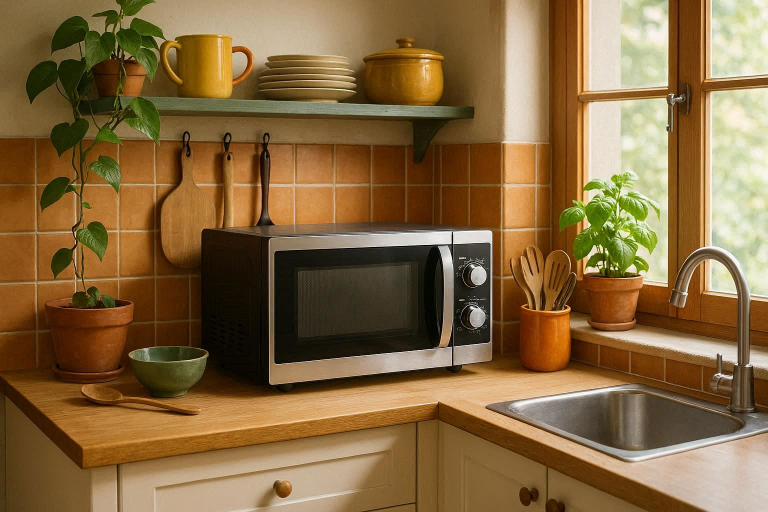
The microwave is arguably one of the most essential—yet awkward—appliances in a modern kitchen. In a sprawling, open-plan space, finding its home is simple. But when you’re working with limited square footage, that standard countertop unit quickly becomes a counter space killer.
For small kitchen owners, every inch of usable surface is gold. That’s why the traditional location—right next to the toaster and coffee maker—simply won’t do.
The good news? Modern design has provided a host of smart, space-saving solutions. From seamless built-ins to clever vertical placements, you can successfully integrate your microwave without sacrificing valuable prep space.
This guide explores 12 expert-approved Best Compact Microwave Ovens options for where to put the microwave in a small kitchen, helping you choose the perfect spot based on your kitchen’s layout, budget, and design style.
The Small Kitchen Microwave Dilemma
The quest for microwave placement often starts with a single, frustrating realization: your kitchen is too small for a cluttered countertop.
A typical countertop microwave can occupy 18 to 22 inches of your limited work surface. Losing that much space Ideas for Kitchen & Living Room compromises your ability to chop vegetables, use a cutting board, or even stage dinner plates.
Why Microwave Placement Matters in a Compact Space
In a small kitchen, placement is less about Best Compact Microwave Ovens convenience and more about maximizing flow, safety, and functionality.
-
Workflow: A well-placed microwave streamlines your cooking process, keeping it near the fridge (for leftovers) and the sink (for cleanup).
-
Safety: The spot must be at a safe height to prevent spills of hot liquids, especially when involving children or elderly family members.
-
Aesthetics: Moving the bulky appliance off the counter creates an immediate sense of openness and a cleaner, more streamlined visual aesthetic.
The best location for your microwave is one that is easily accessible but does not interrupt your primary cooking zones.
The Top 5 Space-Saving Microwave Placement Ideas
These five options are the gold standard for saving counter space in small kitchens, offering a mix of affordability, high-end integration, and convenience.
Over-the-Range (OTR) Microwave
The Over-the-Range (OTR) microwave, also Best Small Microwave Ovens known as a micro-hood, is perhaps the most classic small kitchen solution.
How it works: This is a specialized, all-in-one unit that installs directly above your stove or range, replacing the traditional range hood. It uses the vertical space that would otherwise be dedicated to ventilation.
-
Pro: It’s a two-in-one appliance, saving both counter and wall space. It provides overhead lighting for the cooktop.
-
Con: The height can be awkward or unsafe for shorter individuals or children reaching over a hot stove. Ventilation power is often weaker than a dedicated range hood.
-
Microwave Type: Requires a dedicated Over-the-Range model.
-
Installation: Professional installation is highly recommended as it involves electrical wiring and, potentially, ventilation ductwork.
Built-In Cabinetry (Upper)
Integrating a microwave into your existing upper cabinetry provides a polished, custom look while keeping the appliance at an easy, eye-level height.
How it works: A dedicated cabinet is constructed (or a standard cabinet is modified) to perfectly house the microwave, often using a trim kit to bridge any gaps and provide a seamless, integrated finish. This is a common strategy when pairing it with a wall oven.
-
Pro: Achieves a highly customized, clutter-free, and upscale appearance. Keeps the appliance at a convenient, safe height with a counter nearby for landing space.
-
Con: Requires a specialized built-in model or a standard countertop unit combined with a specific trim kit, increasing cost. It reduces overall cabinet storage.
-
Microwave Type: Built-in model or a specific countertop model with a compatible trim kit.
-
Installation: Moderate to Professional. Modifying an existing cabinet can be complex; best done during a remodel.
The Under-Counter Microwave Drawer
The microwave drawer is the ultimate blend of modern design, ergonomics, and space efficiency. It is consistently Best Small Microwave Ovens rated as one of the best placements for small kitchens.
How it works: This appliance is specifically designed to function as a large drawer, installed in a base cabinet or a kitchen island, opening downward and outward. It eliminates the need to lift hot dishes up and over.
-
Pro: Frees up both counter space and upper cabinet space. It is incredibly safe and accessible for all users (children, the elderly, or those with disabilities) as you load and unload from above. Creates a clean, minimalist look.
-
Con: It is typically the most expensive microwave option. Requires a dedicated electrical outlet inside the cabinet space.
-
Microwave Type: Requires a specialized Microwave Drawer model.
-
Installation: Professional or highly skilled DIY, as it requires specific cabinet dimensions and dedicated wiring.
Floating or Heavy-Duty Wall Shelf
For the budget-conscious or renter, installing a sturdy, dedicated wall shelf can be a perfect DIY solution to relocate a standard countertop model.
How it works: A heavy-duty shelf is securely mounted to wall studs, usually just beneath upper cabinets, providing a designated, above-the-counter nook for your standard microwave.
-
Pro: Inexpensive and a relatively simple DIY fix. It uses unused wall space and keeps the countertop completely clear. You can use any standard countertop microwave model.
-
Con: It must be mounted into wall studs—drywall anchors will not support the weight. The placement of the shelf is dependent on the location of a nearby electrical outlet.
-
Microwave Type: Standard Countertop model.
-
Installation: Easy DIY. Crucial Safety Note: Ensure the shelf rating is well above the microwave’s total weight (microwave + food/liquid).
The Appliance Garage or Pantry Nook
An Appliance Garage or Pantry Nook hides the microwave behind a solid or roll-up door, giving you a completely clean kitchen look when not in use.
How it works: You designate a lower pantry shelf or a dedicated cabinet section with an interior electrical outlet. The microwave is pulled out slightly for use, and the door is closed for a seamless look.
-
Pro: Keeps the microwave out of sight and mind when not in use. It utilizes existing storage space, making it a great option for renters or small budgets.
-
Con: You must leave the door fully open during operation to prevent heat build-up and fire risk. It sacrifices valuable pantry storage space.
-
Microwave Type: Standard Countertop model.
-
Installation: Easy DIY if the cabinet already exists and has an outlet nearby. A professional may be needed to install a new, interior-fed electrical outlet.
Creative & Less Common Placement Solutions
Beyond the top five, there are several other innovative ways to reclaim your countertop, depending on your kitchen’s unique layout.
Corner Countertop or Corner Cabinet
The corner of a countertop is often considered “dead space” because it’s not useful for primary food prep. This makes it an ideal spot to place a small appliance like a microwave.
-
Corner Countertop: Placing a small countertop model in the corner keeps it out of the main work zone.
-
Corner Cabinet: Custom corner base cabinets can be designed with a lazy susan or a fixed shelf to house a microwave, maximizing deep corner space.
Integrated into a Kitchen Island
If your small kitchen design includes a compact kitchen island (or peninsula), this is a prime location for integration.
This often involves installing a Microwave Drawer (Section 2.3) into the island’s cabinetry. This central location makes the microwave accessible from all sides, streamlining the workflow. It also provides a large, immediate landing space on the island’s counter.
On a Rolling Cart or Microwave Stand
For tiny apartment kitchens with no built-in cabinetry options, a rolling kitchen cart offers flexibility.
-
Solution: Purchase a dedicated small utility cart or cabinet stand. Place the microwave on top and store related items (bowls, wraps) below.
-
Flexibility: The cart can be rolled to a more convenient location during use or stored in an adjacent dining room or hallway when you need more space in the kitchen.
Above the Refrigerator (The Height Dilemma)
While it saves space, placing a compact microwave above a low-level fridge can work, but placing it on top of a full-height refrigerator is generally ill-advised.
-
Safety Risk: Retrieving hot food from this height requires an awkward, high reach, posing a major burn risk.
-
Recommendation: Avoid this placement unless you are very tall and have absolutely no other safe options, or if your fridge is specifically a smaller, under-counter model.
Essential Factors for Perfect Microwave Placement
Regardless of which clever spot you choose, certain universal rules apply to ensure the placement is safe, functional, and compliant with appliance guidelines.
Safety and Accessibility (The NKBA Guideline)
Safety is the highest priority. Hot liquids can scald, and poor placement creates trip hazards.
The National Kitchen and Bath Association (NKBA) recommends that the bottom of the microwave be positioned between 24 and 48 inches from the floor.
-
Too Low (Below 24″): Requires excessive bending, making it harder to lift heavy, hot items. A base cabinet drawer is the exception, as the drawer opens and you load from above.
-
Too High (Above 48″): Requires reaching and straining, significantly increasing the risk of spillage and burns. This is particularly important for households with children, the elderly, or those with limited mobility.
Ventilation and Airflow Requirements
Microwaves—especially those built into cabinetry—generate heat and require clear airflow to operate safely and efficiently.
-
Countertop Models: Need at least 3 inches of clearance on the top, sides, and back unless the manufacturer specifies otherwise. Never enclose a standard countertop model without a proper, ventilated trim kit.
-
Built-in Models: Built-in and drawer models are designed with integrated venting and specific dimensions for cabinet cutouts. Always follow the manufacturer’s instructions regarding required cabinet depth and open space.
Kitchen Workflow and Proximity to Other Appliances
Think about your cooking process. Food typically moves from the Fridge/Freezer $\rightarrow$ Prep Area $\rightarrow$ Cooktop/Oven $\rightarrow$ Microwave (for reheating/melting) $\rightarrow$ Table.
The ideal microwave placement should be:
-
Close to the refrigerator for quick reheating of leftovers.
-
Near a landing space (a countertop, island, or pull-out shelf) to immediately set down hot dishes upon removal. Never place it where you have to carry a hot dish across a walkway.
Electrical Outlet Access (Avoid Extension Cords)
Microwaves are high-wattage appliances and should never be plugged into an extension cord.
-
The chosen location must have a dedicated electrical outlet nearby.
-
If you choose a built-in option, you will need a licensed electrician to install a new, dedicated outlet inside the cabinet or wall cavity.
Placement Pros, Cons, and Installation Effort (Comparison)
| Placement Idea | Pros | Cons | Microwave Type Needed | Installation Effort |
| Over-the-Range | Saves counter space; acts as a range hood. | Awkward height over a hot surface; weaker ventilation. | OTR/Micro-hood | Professional |
| Built-In (Upper) | Seamless, high-end look; optimal safe height (36″-48″). | Reduces cabinet storage; higher appliance/trim kit cost. | Built-in or Countertop + Trim Kit | Moderate to Professional |
| Microwave Drawer | Best ergonomics and safety; completely clears counter space. | Most expensive; lowest capacity options. | Specialized Drawer | Professional |
| Wall Shelf | Inexpensive, frees counter space; uses a standard model. | Requires drilling into studs; minimal landing space. | Standard Countertop | Easy DIY |
| Appliance Garage | Hidden/out of sight; uses a standard model; low cost. | Must keep door open during use; sacrifices pantry space. | Standard Countertop | Easy DIY |
| Rolling Cart | Portable and flexible; utilizes a standard model. | Takes up floor space; less permanent/integrated look. | Standard Countertop | Very Easy (No Install) |
Common Microwave Placement Mistakes to Avoid
In the pursuit of space, it’s easy to overlook crucial design and safety errors. Here are five mistakes to avoid when Best Small Microwave Ovens choosing your microwave’s home.
-
Placing a Countertop Model in an Unventilated Cabinet: This is a fire hazard! Standard countertop models must have clearance for heat dissipation. If you want it built-in, you must use a trim kit or a designated built-in model.
-
Locating it Far from a Landing Spot: If you have to carry a scalding bowl of soup more than two steps before setting it down, the placement is too far. Always ensure there is an immediate, stable surface adjacent to the microwave.
-
Hanging it with Weak Brackets: Microwaves are heavy (up to 40 lbs), and when loaded with food, they are heavier. Mounting a shelf or bracket to drywall without locating a stud is a recipe for disaster.
-
Tucking it Next to the Sink or Dishwasher: Water and electricity do not mix. Accidental splashing can short out the appliance or, worse, create an electrical hazard. Keep a safe distance from all water sources.
-
Putting it Over a High-Traffic Walkway: A microwave door that swings open and blocks the path between the sink and the stove is a major workflow impediment and a serious tripping hazard, especially when carrying hot food.
Tips for Choosing the Right Microwave for a Small Kitchen
The key to perfect placement often starts with choosing the right-sized appliance for the job.
-
Downsize Your Microwave: If you only use it for reheating coffee and melting butter, do you need a 1.5 cu. ft. unit? Look at compact or mid-size models (0.7 to 1.0 cu. ft.). They often have smaller footprints (e.g., a shorter depth or width).
-
Embrace Multi-Functionality: Consider a microwave with convection cooking capabilities. This allows your microwave to double as a secondary, small oven, reducing the need for another small appliance on the counter.
-
Look at Door Swing: Before you buy, check the hinge. Most microwaves are left-hinged. Ensure the door swing opens away from your main work area and doesn’t trap you in a corner. Drawer-style and over-the-range models offer pull-down doors, eliminating the side-swing issue entirely.
FAQs
What is the ideal height for a microwave?
The NKBA recommends placing the bottom of the microwave between 24 and 48 inches from the floor. The exact ideal height depends on the primary user; for most adults, shoulder or chest height (around 40-44 inches) is safest and most ergonomic.
Can I put a standard countertop microwave in a cabinet?
You can, but only if you use a professionally installed trim kit or if the cabinet is an open-backed nook with adequate, visible clearance (3+ inches on sides/top) for ventilation. Never place a standard model in an enclosed cabinet and close the door while it’s running—this is a fire risk.
Are microwave drawers worth the cost in a small kitchen?
Yes, they are the best solution for maximizing counter space and improving safety. While expensive, they offer the cleanest aesthetic, free up upper cabinets, and provide the safest height for loading and unloading hot items, making them a premium investment for a small kitchen remodel.
What is an “appliance garage”?
An appliance garage is a designated, recessed storage area, usually on the countertop or built into cabinetry, often with a roll-up or swing-up door. It’s designed to keep small appliances like toasters, blenders, and microwaves plugged in and ready to use, but neatly hidden when not needed.
Is it safe to put a microwave above a stove?
It is safe only if it is a designated Over-the-Range (OTR) model, which includes a built-in fan and lighting. Do not simply put a countertop model on a shelf above your stove, as the heat and steam from the cooktop can damage the unit and it creates an extreme safety hazard when reaching over a hot surface.
Conclusion
Finding the perfect spot for your microwave in a small kitchen is a matter of strategic compromise. By moving the appliance off your precious countertop, you instantly transform your work surface, making your kitchen feel larger, cleaner, and significantly more functional.
Whether you opt for the seamless integration of a Microwave Drawer, the utility of an Over-the-Range unit, or the simplicity of a heavy-duty Wall Shelf, the decision should always balance space-saving capabilities with uncompromising safety and proximity to your kitchen’s main work triangle.