
Choosing the right light bulb for your kitchen is perhaps the most important lighting decision you’ll make in your entire home. The kitchen is a demanding, multi-functional space. It is a work area for chopping, reading recipes, and cleaning; it’s also a gathering spot for dining, entertaining, and relaxing.
This means a single, overhead dome light won’t cut it. You need a layered approach, and the quality of the light—defined by the bulb you choose—is what makes or breaks the entire room.
We’ll cut through the jargon of Kelvin, Lumens, and CRI to give you a straightforward, expert guide. By the end, you’ll know exactly which type of light bulb for kitchen use will perfectly balance function and ambiance in your space.The Ultimate Kitchen Light Bulb Guide: Choosing the Right Type, Color, and Brightness
Understanding Your Kitchen’s Lighting Needs
Before you buy a single bulb, you must understand how your kitchen operates. Think of your lighting as having three essential Ideas for Kitchen & Living Room layers that work together to eliminate shadows and ensure safety. Every kitchen needs all three.
The Three Layers of Kitchen Lighting
-
Ambient Lighting: This is your general, overall illumination. It brightens the room uniformly and is usually provided by recessed lighting, flush mounts, or track lights. Its primary goal is to provide a base level of visibility.
-
Task Lighting: This is focused, high-intensity light directed at workspaces. This layer is critical for safety and precision. It includes under-cabinet strips, pendant lights over an island, and spotlights over the sink.
-
Accent Lighting: This layer adds depth and visual interest. It highlights architectural features, backsplashes, or glass cabinets. Accent lighting is all about creating mood and can often be a warmer color temperature or dimmable.
The type of light bulb you choose will depend heavily on which layer of lighting it is supporting.
Light Bulb Types: Which Technology is Best for the Kitchen?
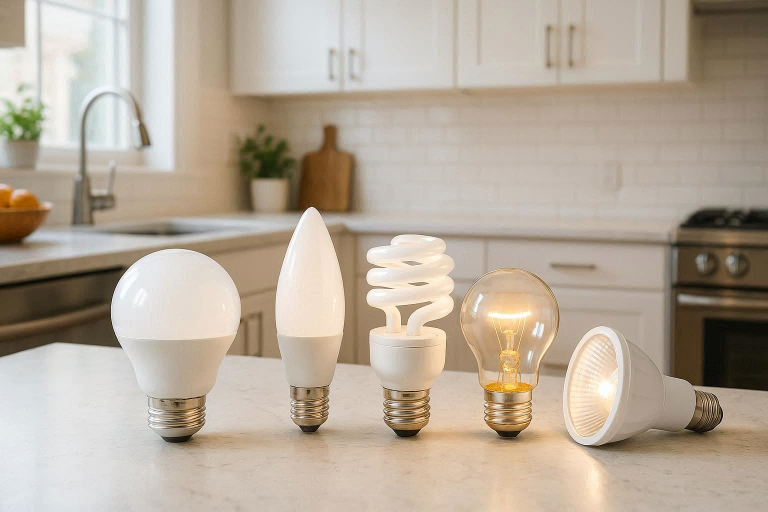
When shopping for any kitchen light bulb, you’ll primarily encounter three main technologies. For modern kitchens, the choice is overwhelmingly clear: LED bulbs.
| Bulb Type | Pros | Cons | Ideal Kitchen Use |
| LED | Excellent energy efficiency, extremely long lifespan, available in all colors/shapes, instant full brightness. | Higher initial cost, light quality (CRI) can vary between brands. | All layers: Ambient, Task, and Accent. |
| Halogen | Excellent color rendering (CRI 100 is common), dimmable, bright. | High heat output, shorter lifespan than LED, less energy-efficient. | Specialty task lighting or high-CRI accent areas. |
| CFL | Energy efficient, low cost. | Contains mercury (disposal required), slow start-up, limited dimming, less attractive. | Not recommended for modern kitchens. |
LED: The Modern Standard
Light-Emitting Diode (LED) bulbs are the undisputed champion for kitchens today. They consume up to 80% less energy than older incandescent bulbs and can last 15-25 years.
Furthermore, modern LED technology offers an immense range of color temperatures and excellent dimming capabilities, making them perfect for every zone in your kitchen.
Halogen and Incandescent: Why They’re Being Phased Out
Incandescent and Halogen bulbs produce a warm, natural light and boast a perfect Color Rendering Index (CRI) of 100 (more on this soon).
However, their massive energy consumption and short lifespan have led to global phase-outs. If you are replacing an old bulb, an LED equivalent is the best long-term choice.
CFL: The Cautious Choice
Compact Fluorescent Light (CFL) bulbs were an early attempt at energy-saving. While cheap, they contain trace amounts of mercury, require special disposal, and often have a slow “warm-up” time to reach full brightness, which is a nuisance in a busy kitchen.
It’s best to avoid CFLs entirely and upgrade to LEDs.
Mastering Color Temperature (Kelvin): The Key to Kitchen Ambiance
The single most critical factor in your kitchen’s atmosphere is the Color Temperature, measured in Kelvin (K). This tells you if the light will feel warm (yellow-white) or cool (blue-white).
In the kitchen, you will likely use a mix of these ranges to define different zones.
Warm White (2700K – 3000K): For Dining and Cozy Areas
This range mimics the traditional glow of an old incandescent bulb. It is soft, cozy, and highly inviting.
-
Best for: Dining nooks, accent lighting, or a traditional/farmhouse-style kitchen where comfort is prioritized over high-task visibility.
-
Feeling: Relaxing, homey, and warm.
Neutral/Cool White (3500K – 4000K): The Best All-Around for Kitchens
This is the sweet spot for the modern, working kitchen. It provides a bright, crisp light that is excellent for most tasks without being overly harsh or clinical.
-
Best for: General ambient lighting, areas with white cabinets or stainless steel, and open-plan kitchens needing a balanced glow.
-
Feeling: Balanced, clear, and energized. This is the recommended default for most primary kitchen lighting.
Daylight (5000K – 6500K): Maximizing Focus and Detail
This light is very bright, with a slight blue tint, and closely simulates natural noon daylight. While some find it too stark, it is fantastic for detailed work.
-
Best for: Dedicated task areas like a laundry zone in the kitchen, a pantry, or under-cabinet lighting directly above a cutting board or work zone.
-
Feeling: Clinical, hyper-focused, and vibrant.
Pro Tip: Aim for consistency between the general kitchen light bulbs (Ambient) and the task lighting. A jump of more than 1000K (e.g., 3000K ambient and 5500K task) can be jarring. Stick to a tighter range, like 3500K for ambient and 4000K for task, for a cohesive design.
Brightness and Function: Understanding Lumens (Not Watts)
A common mistake is thinking in terms of Watts. Watts measure energy consumption; Lumens measure light output (brightness). You can no longer rely on the old “60-watt equivalent” since an LED bulb achieving the same brightness only uses about 10 watts.
When selecting your kitchen light bulb, always look at the Lumen rating.
Calculating How Many Lumens You Need for a Kitchen
The kitchen requires significantly more light than a living room because of the detailed, and often dangerous, tasks performed there (cutting, boiling, reading small print).
Experts recommend aiming for 30 to 40 Lumens per square foot for the combination of ambient and task lighting.
| Kitchen Area | Recommended Lumens |
| General Ambient | 5,000 – 10,000 total Lumens (or 30-40 lumens/sq ft) |
| Task Lighting (Countertops) | 700 – 1,000 Lumens per linear foot of counter |
| Over Dining/Island | 1,500 – 3,000 total Lumens (often from pendant lights) |
Example: A 10×10 kitchen is 100 sq ft. At 35 lumens/sq ft, you need 3,500 total lumens of ambient light. This can be achieved with four 800-lumen (60W equivalent) recessed LED kitchen light bulbs plus your task and accent layers.
The Pro-Tip: Why Color Rendering Index (CRI) is Crucial
The Color Rendering Index (CRI) is an often-overlooked number that is arguably most important in a kitchen setting. CRI measures how accurately a light bulb reveals the true colors of objects compared to natural daylight (which has a perfect CRI of 100).
-
A low CRI light (e.g., 70) makes your food look dull, slightly green, or gray.
-
A high CRI light (e.g., 90+) makes the red of a tomato or the green of a basil leaf pop, giving you a better view of your food and its freshness.
Target CRI for Accurate Food and Color Perception
For any area where you prepare or inspect food, you need high color accuracy.
-
Minimum Acceptable CRI: 80
-
Recommended CRI for Task Lighting (Under-cabinet/Island): 90 or higher
Always check the CRI number on the bulb packaging. A high CRI ensures your culinary creations look as good as they taste and helps you spot ingredients that have gone bad.
Tips for Choosing the Right Kitchen Bulb
Moving beyond color and brightness, two practical considerations—shape/base and controls—will finalize your bulb selection.
Matching Bulb Shapes to Common Fixtures (Recessed, Track, Pendant)
Your light fixture dictates the base and shape you need. LEDs come in equivalents for nearly every traditional style.
-
Recessed Can Lights: These usually require BR (Bulged Reflector) or PAR (Parabolic Aluminized Reflector) shaped bulbs, like the BR30 (standard size) or PAR38 (larger floodlight). They typically have the standard E26 screw-in base.
-
Under-Cabinet Lighting: Most modern fixtures use dedicated LED light strips or puck lights. If replacing older halogen pucks, you may need a small G8 or G4 bi-pin base.
-
Track Lighting: Often requires GU10 or MR16 base bulbs. These are twist-and-lock or bi-pin styles and are excellent for directing a beam of light as task lighting.
-
Pendant Lights: Usually take a standard A19 or decorative G-series (Globe) bulb with an E26 base. Look for “Filament LED” styles for an aesthetic, traditional look.
The Power of Dimmability and Smart Kitchen Lighting
For a space that transitions from intense cooking to casual dining, dimmability is a must.
-
Always Choose Dimmable LEDs: Look for bulbs explicitly labeled “dimmable.” Pair them with a compatible LED dimmer switch to prevent flickering or buzzing.
-
Smart Bulbs: A smart kitchen light bulb (often Wi-Fi or Bluetooth-enabled) allows you to use your phone or voice assistant to change both the brightness and the color temperature. You can set a “Chef Mode” at 4000K/95 CRI and a “Dinner Party Mode” at 2700K/90 CRI with a single command. This versatility makes them ideal for a multi-use kitchen.
Common Kitchen Lighting Mistakes to Avoid
Even with the right knowledge, it’s easy to make small mistakes that spoil the look and function of your kitchen.
Mistake 1: Using Low CRI Bulbs
This is the most common mistake in budget installations. A cheap, low-CRI bulb (below 80) will save you money but make all your food and surfaces look washed out and unappetizing. Always prioritize high CRI light bulbs for the kitchen—it is worth the extra cost.
Mistake 2: Mixing Color Temperatures Within the Same Space
While layering is good, mixing a 5000K bulb in one fixture with a 2700K bulb in another nearby fixture creates a visually cluttered, unpolished look. Keep all bulbs within the same area (e.g., all recessed cans) within 300-500K of each other. Consistency is key to a professional feel.
Mistake 3: Underestimating Lumens for Task Areas (Sinks and Counters)
The darker the countertop, the more light you need. If you have dark granite or slate, you need significantly more focused Lumens than if you have white quartz. An under-cabinet strip that seems “bright enough” when tested on its own may still leave shadows once you stand at the counter and block the overhead light.
Ensure your task lighting is focused directly on the work surface and has a high lumen count.
FAQ:
What are the best types of light bulbs for recessed kitchen lighting?
The best type is a Dimmable LED BR30 or PAR38 bulb. Choose a color temperature between 3500K and 4000K for general ambient lighting, and aim for a CRI of 90+.
Should I use warm white or cool white in a white kitchen?
For a pure, clean look in a white kitchen, you should lean towards Neutral/Cool White (4000K). This temperature prevents the white surfaces from taking on a yellow tint (which happens with 2700K bulbs) and keeps the space looking bright and crisp.
What does the “E26” or “GU10” on a light bulb mean?
These are the base codes. E26 is the standard screw-in base found in North America (Edison 26mm). GU10 is a common two-pin, twist-and-lock base often used for recessed lighting in European-style fixtures, track lights, and sometimes pendant lighting.
How often should I replace LED kitchen bulbs?
High-quality LED bulbs are rated to last between 15,000 and 25,000 hours, which translates to 15 to 25 years of average household use. Unlike traditional bulbs, you will rarely, if ever, have to replace them.
Is it safe to use a standard bulb in a dimmer switch?
No. You must only use bulbs explicitly labeled as dimmable. Using a non-dimmable LED bulb in a dimmer circuit will typically result in flickering, buzzing, or premature bulb failure. Always check the packaging for the “Dimmable” designation.
Conclusion:
Selecting the correct type of light bulb for your kitchen is a process that moves beyond simple wattage. The modern kitchen demands a high-performing LED bulb that excels in three key areas:
-
Technology: Choose LED for efficiency and longevity.
-
Color Temperature (K): Aim for 3500K to 4000K as your primary operating color to balance energy and warmth.
-
Color Accuracy (CRI): Insist on a CRI of 90+ for all task lighting to ensure your food and countertops look perfect.
By focusing on these three factors and applying the layer approach (Ambient, Task, Accent), you will transform your kitchen from a dimly lit workspace into a bright, beautiful, and highly functional center of your home.