
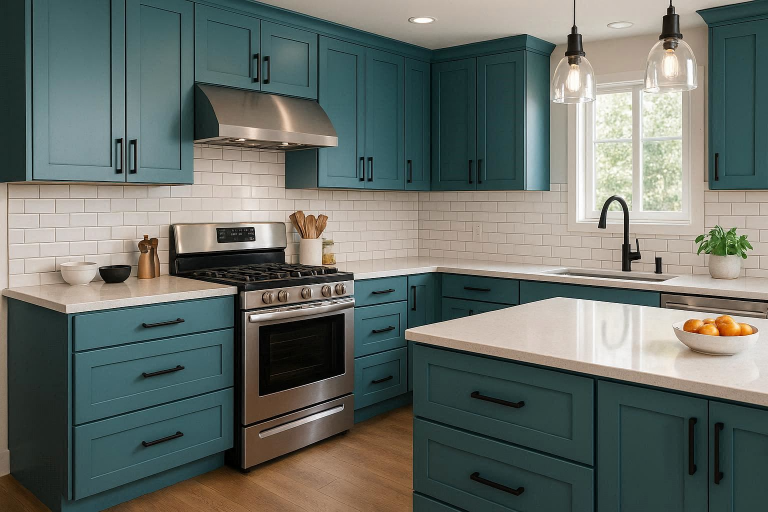
Ready-to-Assemble, or RTA kitchen cabinets, have completely changed the game for home renovation. They represent the single largest opportunity to save money on a kitchen remodel without sacrificing quality or style.
For years, RTA cabinets were dismissed as “cheap” or “IKEA-grade” furniture.Today, thanks to advances in manufacturing and high-quality materials, they are a powerful alternative to expensive custom and semi-custom cabinetry. But what exactly are RTA cabinets, and are they the right choice for your home?
In this ultimate guide, we’ll break down the definition, compare them to traditional cabinets, show you what to look for, and give you the actionable steps you need to buy and build them successfully.
What Are RTA Kitchen Cabinets? A Simple Definition
RTA kitchen cabinets (Ready-to-Assemble) are pre-manufactured cabinet components that are shipped in a flat-pack format. They are designed to be easily assembled by the customer or a contractor on-site.
Think of them like an advanced, high-quality furniture kit specifically for your kitchen.
When you purchase RTA cabinets, the parts arrive in separate, compact boxes. These boxes contain everything you need to build a complete cabinet:
-
The sides, tops, and bottom panels for the cabinet box.
-
The face frame (if applicable).
-
Drawer boxes and door fronts.
-
All necessary assembly hardware (screws, dowels, hinges, glides).
The key difference from other cabinet types is that the manufacturing is complete—all pieces are cut, drilled, finished, and ready—but the labor of assembly is left to the buyer. This is what unlocks the significant cost savings.
RTA vs. Pre-Assembled Cabinets: A Side-by-Side Comparison
The choice between RTA and pre-assembled cabinets often comes down to a simple trade-off: saving money versus saving time. While both options can offer excellent quality, they differ greatly in cost, logistics, and installation.
| Feature | RTA (Ready-to-Assemble) Cabinets | Pre-Assembled (Stock) Cabinets |
| Delivery Format | Flat-packed components in compact boxes. | Fully constructed, ready-to-hang cabinet boxes. |
| Cost | Significantly lower (often 30–50% less). | Higher due to factory labor and shipping volume. |
| Assembly | Required (DIY or hire a handyman). | Not required; ready to be installed directly. |
| Lead Time | Very fast (“Quick Ship” in days or weeks). | Varies, but generally longer (weeks to months). |
| Shipping | Cheaper and less prone to shipping damage due to flat packaging. | More expensive and higher risk of damage due to size. |
| Ideal For | DIY enthusiasts, budget-conscious homeowners, smaller projects. | Customers prioritizing speed and convenience, complex layouts. |
Cost Savings: Where the RTA Magic Happens
The primary appeal of RTA cabinets is the dramatic reduction in cost. This is not because the materials are inherently cheaper (though budget options exist), but because you eliminate two huge expenses:
-
Factory Labor: You cut out the labor costs associated with assembling the cabinets at the manufacturing facility.
-
Shipping Volume: Flat-packed boxes take up significantly less space, leading to lower freight and delivery charges.
On average, a homeowner can save between 30% and 50% compared to an identical pre-assembled product, which often translates to thousands of dollars on a full kitchen remodel.
Shipping and Lead Time Differences
When planning a renovation, lead time is critical.
Pre-assembled and custom cabinetry often require RTA Kitchen Cabinets long manufacturing periods. You can be waiting weeks or even months for your order.
RTA cabinets, by contrast, are typically in-stock and can often be shipped in as little as 3-10 business days. This “quick ship” option is a massive benefit for homeowners under a tight deadline.
Installation Time and Effort
The key drawback for many is the required time investment.
While assembling a single RTA wall cabinet might only take an experienced DIY enthusiast 10-15 minutes, a full kitchen can take a beginner many days or even a week.
You must be honest about your skill level and how much time you are willing to dedicate to the project. If you have the time and enjoy working with your hands, RTA is an ideal fit.
The 5 Major Benefits of Choosing RTA Cabinets
The modern Ready-to-Assemble market offers compelling advantages beyond just the price tag:
-
Superior Affordability: This remains the undisputed #1 benefit. The cost-to-quality ratio is unmatched, allowing you to afford premium features (like all-plywood construction) that would be out of budget in pre-assembled lines.
-
Exceptional Durability and Quality: Reputable brands use the same high-quality materials—such as solid wood face frames and Grade-A plywood cabinet boxes—as their pre-assembled counterparts. The only difference is who screws them together.
-
Fast Turnaround Time: With most orders shipped within days, RTA drastically shortens the waiting period for your materials, accelerating your renovation timeline.
-
DIY-Friendly Sense of Accomplishment: For many, successfully building and installing their own cabinets provides a huge sense of pride and ownership over their new kitchen space. The assembly process is generally straightforward with pre-drilled parts and clear instructions.
-
Less Risk of Shipping Damage: Cabinets are best protected when they are flat. The compact packaging minimizes the surface area exposed to potential bumps and scratches during transit.
3 Common Drawbacks of Ready-to-Assemble Cabinets
Despite the benefits, RTA is not the perfect solution for Organization Ideas for Kitchen & Living Room every scenario. It’s important to acknowledge the trade-offs.
-
Assembly is Required: This is the most obvious con. It requires a significant time commitment and a minimal degree of handiness. If you lack the patience, tools, or time, you will need to budget for professional assembly, which cuts into your initial cost savings.
-
Limited Customization: While RTA offers a vast array of styles, colors, and configurations, the sizing is standardized (stock sizes). If your kitchen has odd dimensions, tricky corners, or requires very specific cabinet depths, you might need to use filler pieces or choose a semi-custom option.
-
Potential for Warranty Issues: Most manufacturers offer excellent product warranties (often a lifetime warranty for high-quality lines). However, if a problem arises and it is determined that the cabinet failed due to improper assembly or installation by the homeowner, the manufacturer may void the warranty. Always follow the instructions precisely.
Quality Matters: Materials and Construction You Should Look For
The quality of an RTA cabinet is not defined by its assembly, but by its core materials and construction methods. Don’t be fooled by the low price; a high-quality RTA cabinet should be just as durable as a custom one.
Cabinet Box Construction: Plywood vs. MDF
The cabinet box is the structural heart of the unit. You will typically find a choice of two core materials:
-
Plywood: The superior choice. Plywood is made from thin layers of wood veneer glued together, providing exceptional strength, screw retention, and stability. It is highly resistant to moisture (a major plus for kitchens). Look for $1/2$ to $3/4$ inch furniture-grade plywood.
-
MDF (Medium-Density Fiberboard) / Particleboard: These are budget options made from wood fibers or chips pressed with resin. They are fine for cabinet doors with a laminate finish, but they are heavier, much more susceptible to water damage, and hold screws less securely than plywood. Always choose plywood for your base and wall cabinets if your budget allows.
The Strength of Dovetail Joints
When evaluating RTA quality, look at how the drawer boxes are constructed. The gold standard is the dovetail joint.
Dovetail joints feature interlocking, fan-shaped tenons and pins, creating a connection that is extremely resistant to being pulled apart. A drawer with dovetail construction is a clear indicator of a high-quality product that will stand up to years of heavy use.
Must-Have Hardware: Soft-Close and Full-Extension Glides
High-quality RTA lines should include premium hardware as a standard feature:
-
Soft-Close Hinges: These prevent cabinet doors from slamming shut, protecting the cabinet structure and eliminating noise.
-
Soft-Close, Full-Extension Drawer Glides: Full-extension glides allow you to pull the drawer completely out of the cabinet, giving you full access to items in the back. The soft-close feature ensures smooth, silent operation.
This premium cabinet hardware is a must-have for a modern kitchen experience.
Assembly Explained: Types of RTA Cabinet Joints
The way an RTA cabinet’s components connect is a major factor in its ease of assembly and overall long-term strength.
Cam Lock Assembly
The cam lock system is perhaps the most common type seen in furniture today.
-
How it works: A small, round, metallic cam is inserted into a pre-drilled hole. A metal pin or bolt from the adjoining piece is inserted into the cam. Turning the cam locks the two pieces securely together.
-
Pros: Very fast, requires no glue, and is simple for a beginner.
-
Cons: Can loosen over time and is generally considered the weakest joint type.
Metal Clip Assembly
A step up from the cam lock, the metal clip system uses specialized brackets or clips that interlock the cabinet components, secured with a few screws.
-
How it works: Pre-installed metal clips on one panel slide into grooves or receiving plates on the second panel and are then secured with screws.
-
Pros: Stronger than cam locks, simple installation, and very durable.
-
Cons: The metal clips may be visible on the finished inside of the cabinet box.
Dovetail Assembly
This is the strongest and most sophisticated method, often found in high-end RTA lines.
-
How it works: The cabinet sides interlock using the same highly durable dovetail joint pattern used for drawer boxes. These joints are typically glued and then reinforced with screws.
-
Pros: Creates an incredibly strong, rigid, and long-lasting cabinet box. Offers a seamless, clean appearance.
-
Cons: Requires more precision and is slightly more complex to assemble than cam or clip methods, often requiring wood glue and a rubber mallet.
Mistakes to Avoid When Buying and Assembling RTA Cabinets
Even the best cabinets can fail if the buying or assembly process is flawed. Be aware of these common pitfalls.
Mistake 1: Compromising on Core Materials
The single biggest error is choosing the cheapest RTA line with particleboard boxes to save an extra 5-10%. Particleboard warps and swells if exposed to moisture (a given in a kitchen) and can destroy your entire investment. Always choose plywood construction. It’s the difference between a cabinet that lasts 5 years and one that lasts 20.
Mistake 2: Failing to Measure Correctly
When ordering RTA cabinets, there is no wiggle room for mistakes. Unlike a semi-custom cabinet, you can’t adjust the dimensions.
-
Actionable Tip: Measure your space three times. Use a laser measure. Account for out-of-square walls, window trims, and appliance placement. Create a simple sketch or use the free design services offered by most reputable RTA retailers.
Mistake 3: Skipping Dry Assembly or Pre-Gluing
For the strongest cabinets, especially those using dovetail joints, you should always dry-fit the components before adding glue.
-
Assembly Tip: After a successful dry-fit, take the piece apart, apply a small bead of quality wood glue to the joints (where recommended by the manufacturer), and then reassemble. Use clamps (or a few well-placed screws) to ensure a tight, secure bond.
Your RTA Cabinet Buying Checklist: 5 Steps to Success
Ready to make a purchase? Use this checklist to ensure you select the best RTA cabinets for your renovation.
Step 1: Confirm Your Kitchen Design and Layout
Before you spend a penny, you need a finalized floor plan.
-
Determine the exact quantity and sizes of all your base cabinets (lower) and wall cabinets (upper).
-
Account for specific units like a lazy Susan, pantry cabinet, or drawer bases.
Step 2: Order Door Samples and Core Material Swatches
Never buy RTA cabinets based only on a website photo. Color, finish, and texture can look drastically different in your home’s lighting.
-
Most suppliers offer samples (often refundable). Order one of the door styles and a core sample (plywood or MDF) to assess quality first-hand.
Step 3: Verify the Hardware Quality (Hinges and Glides)
Check the manufacturer’s specification sheet. Look for the following high-quality components:
-
Soft-Close hinges and glides.
-
Six-way adjustable hinges for easy door alignment.
-
Full-extension drawer glides with a high weight rating.
Step 4: Check Shipping Fees and Warranty Details
Calculate the total delivered cost, including shipping (which can be substantial).
-
Look for retailers offering free shipping over a certain order value.
-
Read the warranty policy carefully, especially regarding damage and proper assembly.
Step 5: Budget for Necessary Assembly Tools
While RTA cabinets require fewer tools than custom builds, you will need a few essentials:
-
Rubber mallet for tapping joints together.
-
A good-quality drill/driver.
-
Wood glue (if not supplied or if you opt for the dovetail/glue method).
-
A level and measuring tape for installation.
FAQs
How long do RTA cabinets last?
High-quality RTA cabinets made with all-plywood construction, solid wood door frames, and dovetail joints can easily last 15 to 20 years or more, which is comparable to many mid-range pre-assembled and stock cabinets. Their lifespan is directly related to the material quality and the care taken during assembly.
Are RTA cabinets difficult to assemble?
No. While they require time, RTA cabinets are designed to be easily assembled by a non-professional. Most manufacturers use pre-drilled holes, dowels, and simple lock systems. The learning curve is steep—the first cabinet will take the longest, and the rest will be much faster.
Will RTA cabinets affect my home’s resale value?
If you choose high-quality RTA cabinets (plywood boxes, solid wood doors) and assemble/install them correctly, they will not negatively affect your resale value. Buyers see a beautiful, functional, and recently updated kitchen. However, poorly assembled or cheap particleboard RTA cabinets will look cheap and hurt your resale value.
Do RTA cabinets come with all the hardware?
Yes. RTA cabinets typically come with all the necessary assembly hardware, including screws, clips, dowels, hinges, and drawer glides. You will need to purchase decorative items like knobs or pull handles separately.
What tools do I need to assemble RTA cabinets?
The basic tools required are a Phillips head screwdriver (or a power drill with a Phillips bit), a rubber mallet, wood glue (for certain joints), and a tape measure. For installation, you’ll also need a level, stud finder, and possibly shims.
Final Verdict: Are RTA Cabinets Worth the Time and Effort?
For the vast majority of homeowners embarking on a kitchen renovation, the answer is a resounding yes.
If you are a DIY enthusiast or are willing to spend the time for assembly—or hire a handyman for the job—RTA cabinets deliver an unparalleled balance of premium aesthetics, long-term durability, and maximum affordability.