
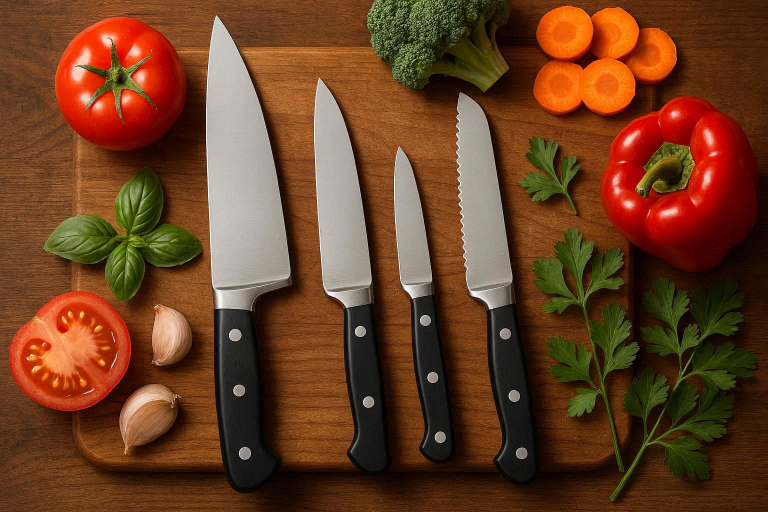
You’ve stood in front of the knife display at the store, staring at those intimidating 18-piece blocks filled with mystery blades. The truth is, most of those knives will sit untouched, dull, and gathering dust.
Building a truly effective, professional-grade kitchen doesn’t require a massive set. It requires a handful of high-quality, purpose-driven tools that you know how to use and, critically, how to care for.
For 90% of all kitchen tasks—from mincing garlic to slicing a roast—you only need three essential knives. Everything else is a specialized addition to perfect a specific craft. This guide will help you ditch the clutter and invest only in the tools you actually need for years of effortless meal prep.
Why You Don’t Need a 15-Piece Knife Block
In the world of professional cooking, the mantra is “quality over quantity.”
Knife blocks are often filled with low-to-mid-grade steel blades that look impressive but lack the edge retention and balance of a single, Kitchen Appliances for Small Homes well-made knife. They are designed to sell a collection, not to be the best tool for every job.
Your Goal: Start with the Core Trio, learn to use and maintain them, and only add specialty knives as your cooking needs evolve.
This minimalist approach focuses your budget on better steel and construction, which translates to safer, more efficient cutting.
The Essential Core Trio: 3 Knives That Do Everything
If you are only going to own three knives, make them these three. This trifecta can accomplish virtually every food preparation task you will encounter in a home kitchen.
The Kitchen Workhorse: The Chef’s Knife
This is, without question, the most important knife in your collection. You will use it for everything from chopping bulky vegetables to mincing fine herbs and even basic meat fabrication.
The Chef’s knife features a broad, curved blade, typically 8 to 10 inches long, that allows for a smooth, rocking motion on the cutting board. This motion is key to efficient chopping and slicing.
Core Functions:
-
Chopping, Dicing, and Mincing: Onions, carrots, celery, potatoes, and garlic.
-
Slicing: Meats, firm fruits, and larger vegetables.
-
Basic Fabrication: Breaking down whole chickens or smaller cuts of meat.
-
Crushing: Using the broad, flat side of the blade to smash garlic cloves.
German vs. Japanese Chef’s Knife: Which is Right for You?
The two main schools of knife design have fundamentally different feels and uses. Understanding this difference is crucial for selecting a Chef’s knife that matches your cooking style.
| Feature | German Style (e.g., Wüsthof, Zwilling) | Japanese Style (e.g., Santoku, Gyuto) |
| Blade Profile | Curved edge, thick spine. | Straighter edge, thinner spine. |
| Action | Rocking motion (for speed chopping). | Push-cut/Slicing (for fine, straight cuts). |
| Weight/Feel | Heavier, with a full bolster for balance and comfort. | Lighter, more agile, and often tip-heavy. |
| Steel Hardness (HRC) | Softer (around 56 HRC); easier to sharpen but dulls faster. | Harder (60+ HRC); holds a razor edge longer but more brittle. |
| Best For | Everyday volume chopping, durability, and hard-skinned produce (squash). | Precision slicing, vegetable-heavy prep, and delicate cuts. |
Tip: If you prefer a powerful, durable knife that’s easy to maintain with a honing steel, choose German. If you prioritize a razor-sharp, lightweight blade for precise work, choose Japanese.
Precision in Your Palm: The Paring Knife
The Paring knife is the small, nimble blade of the trio, usually 3 to 4 inches long. It is designed for tasks where control and precision are more 7 Kitchen Knives Every Cook Needs important than sheer cutting length.
It’s often used in the hand, off the cutting board, making a comfortable and secure grip essential.
Core Functions:
-
Peeling: Fruits and vegetables (though a peeler is often faster).
-
Trimming and Hulling: Removing strawberry hulls, cutting out potato “eyes,” and trimming fat.
-
Detail Work: Creating garnishes, deveining shrimp, or segmenting citrus fruit.
-
Small Slicing: Cutting small ingredients like shallots, garlic, or chives when a Chef’s knife feels cumbersome.
The Saw for Soft and Hard: The Serrated (Bread) Knife
The third essential knife is the serrated knife, most commonly known as the bread knife. Its distinctive saw-like edge is designed to cut through tough exteriors without crushing the soft interior beneath.
This is the only knife in the trio that should not be used for daily chopping and slicing on a board.
Core Functions:
-
Bread: Slicing crusty baguettes, sourdough, or soft sandwich loaves without squishing.
-
Delicate Baked Goods: Leveling cake layers, slicing soft rolls, or cutting pastries.
-
Waxy/Slippery Skins: Cutting through thick-skinned produce like melons, pineapples, tomatoes, and winter squash where a straight edge might slip.
Level Up Your Kitchen: 5 Specialty Knives to Consider Next
Once you master your core trio, you may find yourself struggling with a specific, recurring task. This is when you consider adding a specialized blade.
The Utility/Petty Knife: The Versatile In-Between
Many home cooks find the gap between an 8-inch Chef’s knife and a 3.5-inch Paring knife too large. The Utility or Petty knife (4-7 inches) fills this void perfectly.
It’s essentially a miniature Chef’s knife, ideal for preparing smaller ingredients or for cooks who find a full 8-inch blade unwieldy. It handles tasks like slicing sandwiches, preparing cheese, or managing smaller produce.
The Santoku Knife: The Japanese All-Purpose Alternative
The Santoku is the most popular Japanese all-purpose knife and is often a direct replacement for the Western-style Chef’s knife. Its name means “three virtues” (meat, fish, and vegetables), highlighting its versatility.
It features a flat cutting edge, making it excellent for a strict up-and-down “push-cut” motion rather than the German “rocking” chop. Many Santoku blades have dimples (a Granton edge) to help food release from the blade, improving efficiency.
The Boning Knife: For Meat and Fish Preparation
If you regularly buy whole cuts of meat or fish, a Boning knife is indispensable. It features a thin, narrow blade, often with a slight curve and a pointed tip, to cleanly separate meat from the bone, remove skin, or trim fat.
-
Flexible Blade: Best for delicate tasks like filleting fish.
-
Stiff Blade: Better for heavier-duty butchery and working around tougher joints.
The Carving/Slicing Knife: For Roasts and Holiday Meals
A Carving knife features a long, narrow blade (typically 10-15 inches) with a sharp, pointed tip. It’s designed for cutting uniform, thin slices of cooked meat like turkey, roast beef, or ham.
Often, it is paired with a carving fork to hold the meat steady while you slice. A long, straight blade ensures even slices from top to bottom of a large roast.
The Cleaver: Power and Bone-Breaking
The Cleaver is the heavy, rectangular brute of the kitchen. While often intimidating, its sheer weight and thick spine make it perfect for two very specific tasks:
-
Breaking Down Bone: Using its heft to chop through joints and small bones.
-
Scooping/Transferring: The wide, flat side is an excellent, large-surface tool for scooping chopped ingredients off the board and into a pot.
Beyond the Blade: Crucial Knife Buying Tips
A great knife is more than just a sharp edge. It’s a tool built for longevity, safety, and comfort. Keep these key factors in mind before you purchase any new blade.
Understanding Blade Material: Stainless vs. High-Carbon Steel
-
Stainless Steel (or High-Carbon Stainless Steel): This is the most common material for home kitchens. It is highly resistant to corrosion (rust) and is relatively easy to sharpen. The trade-off is that it typically requires more frequent honing to maintain its edge. This is an excellent choice for most home cooks.
-
High-Carbon Steel (True Carbon Steel): Lacks the chromium of stainless steel, meaning it can rust and stain (develop a patina). However, it can take an incredibly fine, razor-sharp edge and hold it longer. Requires more diligent care.
LSI Terms to Note: Full Tang (the metal piece extends through the handle), Bolster (the thick junction between the blade and handle), and Edge Retention.
Handle Comfort and Balance: The Key to Safety
You’ll be spending a lot of time with your knife, so its comfort is paramount.
A safe knife is a comfortable knife. A great knife should feel like an extension of your arm, not a clumsy weight you have to wrestle.
-
Balance: The balance point should be right where the handle meets the blade (the bolster). This allows the knife to pivot naturally around your grip, making the rocking motion much easier.
-
Handle Material: Wood, composite (like Pakkawood), and synthetic materials (like Fibrox) all offer different grips. Choose one that feels secure and non-slip, even when wet or greasy.
Honing vs. Sharpening: Maintaining Your Edge
Many people use a honing rod (the steel stick) incorrectly, or confuse it with sharpening. They are two distinct practices:
| Practice | Purpose | Tool | Frequency |
| Honing | Realignment. Pushes the microscopic edge of the blade back into the center, improving performance. | Honing Steel or Ceramic Rod | Before every use or every other use. |
| Sharpening | Material Removal. Grinds away steel to create a brand new, sharper edge bevel. | Whetstone, Electric Sharpener, or Professional Service | Every 3–12 months, depending on use. |
Actionable Tip: Always hone your Chef’s knife before you begin a major prep task. This simple habit will dramatically improve your knife’s performance and safety.
Common Kitchen Knife Mistakes to Avoid
A few common missteps can quickly ruin your high-quality investment and even create dangerous situations.
-
Washing in the Dishwasher: The high heat, strong detergents, and blade-banging inside the machine will quickly dull the edge and can damage the handle material. Always hand-wash and dry immediately.
-
Storing Loose in a Drawer: Allowing a sharp blade to rattle around in a drawer will chip the edge and can be a major safety hazard. Use a magnetic strip, a knife block, or a dedicated in-drawer organizer.
-
Cutting on the Wrong Surface: Cutting on materials like granite, marble, glass, or steel is like grinding your blade against a sharpening stone—in a bad way. Always use a soft cutting surface like wood or polyethylene (plastic).
-
Neglecting Your Edge: Using a dull knife requires more force, leading to slips and greater danger. A dull knife is actually far more dangerous than a sharp one. Honing and sharpening are non-negotiable parts of ownership.
FAQs
What is the ideal size for a Chef’s Knife?
The most common and versatile size for a home cook is an 8-inch Chef’s knife. It offers an excellent balance between cutting power for large items and maneuverability for small-to-medium tasks. Cooks with smaller hands or limited counter space might prefer a 6-inch or 7-inch blade.
Should I buy a knife set or individual pieces?
Always buy individual pieces. Sets are generally lower quality and include knives you will never use. Invest your money in a high-quality Chef’s knife, Paring knife, and Serrated knife first. You can always add specialty knives later.
How often should I sharpen my knives?
It depends on the quality of the steel and how often you cook. A general guideline for a high-quality, frequently used stainless steel knife is to sharpen it on a whetstone or have it professionally sharpened every 6–12 months. Remember to hone the blade before almost every use to maintain the sharpness between sharpening sessions.
What is a Santoku knife used for compared to a Chef’s knife?
The primary difference is the cutting motion. A Chef’s knife has a curved belly for a rocking motion, which is great for fast, volume chopping. A Santoku has a flatter edge, designed for a clean up-and-down slicing or push-cut motion, which provides superior precision for thinner slices and dicing.
Can a Serrated knife be sharpened?
Yes, but not with a standard whetstone or honing rod. Serrated knives must be sharpened using a special rod or tool that fits into the gullets (the dips) of the serrated edge. This is a complex task, and many home cooks simply rely on professional services or replace their inexpensive serrated knife when it becomes too dull.
The Minimalist Knife Collection: Your Next Steps
Building your ideal knife collection is a journey, not a single purchase. The most important step is to commit to quality and focus on the essential Core Trio.
-
Buy a High-Quality 8-Inch Chef’s Knife: Choose German (for durability and rock-chopping) or Japanese (for precision and fine slicing) based on your personal preference.
-
Add a 3.5-Inch Paring Knife: Don’t splurge here; a good, lightweight, plastic-handled paring knife is often the most comfortable and functional.
-
Complete the Trio with a Serrated Knife: A 9 or 10-inch serrated bread knife is ideal for crusty loaves and delicate cakes.
Master these three, keep them sharp, and your efficiency and enjoyment in the kitchen will soar. Happy chopping!