
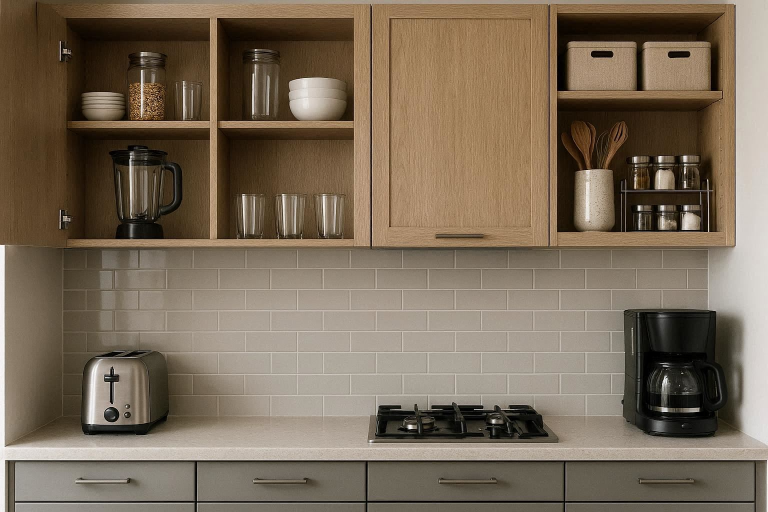
If your kitchen counters are starting to resemble an appliance showroom, you’re not alone. The sheer volume of modern kitchen gadgets—from air fryers and Instant Pots to high-speed blenders and espresso machines—makes maintaining a clutter-free space a genuine challenge.
Finding the perfect home for your electric griddle, slow cooker, and hand mixer is key to unlocking a functional, beautiful kitchen.
The best strategy for deciding where to store kitchen appliances isn’t about fitting everything into a random cupboard. It’s about optimizing your kitchen design for accessibility and frequency of use.
This comprehensive guide will help you create a streamlined system that puts daily-use items front and center, while safely tucking away the gadgets you only pull out occasionally.
Understanding the Appliance Storage Strategy: The Frequency Rule
The secret to a beautifully organized kitchen lies in a simple, three-part system: the Frequency Rule. Your storage location should directly correspond to how often you reach for an appliance. This simple principle preserves your precious countertop real estate for food prep, not storage.
-
Daily/Frequent Use: Keep these items within arm’s reach. They’ve earned their spot on the counter or in an immediately accessible, plugged-in space. (Think coffee maker, toaster).
-
Often-Used (Weekly/Bi-Weekly): These need to be stored in an accessible location, like a lower cabinet or pantry shelf, but do not require permanent counter space. (Think blender, food processor).
-
Occasional/Seasonal Use: Tuck these items away in less convenient spots, like a top shelf, deep corner, or auxiliary storage area. (Think waffle maker, ice cream maker, roaster).
By applying this filter, you instantly identify which appliances are contributing to functional organization and which are simply causing clutter.
Best Storage for Daily and Frequent-Use Appliances
Appliances you use every day, like your Kitchen Appliances for Small Homes kettle or coffee machine, need to be easy to grab, use, and put back. For these devices, it’s often best to keep them plugged in and ready to go.
The Power of the Appliance Garage
An appliance garage is the gold standard for daily-use appliances. It is a dedicated cabinet built into or placed on the countertop, usually with a roll-up, flip-up, or bi-fold door.
The beauty of the appliance garage is twofold: it provides a tidy appearance when the doors are closed and often features installed power points inside. This means you can use the appliance—like a toaster or air fryer—right where it sits, and simply close the door when finished.
-
Pro Tip: Ensure your appliance garage is designed with proper ventilation. Appliances that generate heat or steam (like a kettle) should be pulled out onto the counter or used with the door fully open to prevent damage to the cabinet interior.
Dedicated Coffee and Tea Stations
Creating a centralized “station” for a specific task vastly improves kitchen flow and reduces mental clutter. A coffee or tea station can be a small area of the counter, a dedicated cabinet, or even a rolling cart.
This zone should house everything you need for the task:
-
Appliances: Espresso machine, coffee maker, electric kettle.
-
Accessories: Mugs, coffee beans, filters, sugar, and tea bags.
By dedicating a cabinet near the station to related items, you minimize the number of steps required for your morning routine.
Stylish Countertop Display (When it Works)
Sometimes, the simplest solution is to leave an appliance out, but only if it’s aesthetically pleasing and used daily.
A beautifully designed stand mixer (like a KitchenAid) or a sleek, stainless steel toaster may be an intentional part of your kitchen’s decor. However, it’s critical that these items earn their prime position. If you only bake once a month, that gorgeous mixer belongs in a cupboard.
Smart Storage for Often-Used Appliances (Weekly/Bi-Weekly)
Appliances in this category—such as a personal blender for weekend smoothies or a food processor for weekly meal prep—need to be stored in a way that minimizes the effort required to retrieve them.
Maximizing Cabinet and Pantry Space
Cabinets and pantries are the workhorses of appliance storage. The key to successful utilization is to avoid the “deep dark cabinet” syndrome where items are stacked or buried.
-
Strategy: Utilize the front space of cabinets and the lower shelves of a pantry for your heavier, more frequently used items.
-
Grouping: Store like with like. For instance, put your hand mixer and its attachments in the same cabinet as your baking ingredients. Keep your Instant Pot near your dry rice and beans. This is called zoning.
Deep Drawers and Pull-Out Shelves
One of the best modern kitchen design features for appliance storage is the deep drawer or pull-out shelf.
-
Deep Drawers: These are ideal for storing medium-sized, heavy appliances, like a crockpot, rice cooker, or even an air fryer (check weight limits). They allow you to pull the entire contents out for easy access without having to lift heavy objects off a low shelf.
-
Pull-Out Shelves: Installing sliding trays or pull-out shelves in base cabinets makes accessing items stored in the back much easier. This is highly effective for appliance sets with multiple parts, like a large food processor.
Utilizing Corner Cabinets Effectively
Corner cabinets are notorious for being awkward, yet they offer a surprising amount of storage space. They are excellent for storing bulky appliances that are often-used, but don’t require daily access.
-
Solution: Install a Lazy Susan (turntable) or a swing-out corner cabinet organizer. These allow you to rotate or pull the shelf completely out, bringing the appliances from the deep corner right to you. This is a game-changer for items like pressure cookers or large stock pots.
Hiding Away Occasional and Seasonal Appliances
Appliances you use infrequently—like a bread maker, fondue set, or ice cream maker—should be kept out of your primary kitchen zones. This frees up prime space for your daily cooking tools.
The Role of the Utility Closet or Auxiliary Storage
Don’t feel limited to the kitchen itself. If space is tight, consider secondary storage locations:
-
Utility or Linen Closet: A nearby closet can house appliances that are only used during holidays or for special events.
-
Garage or Basement Shelving: For truly seasonal or once-a-year items (like a turkey roaster or large juicer), a sturdy wire shelf in a dry, accessible area outside the main kitchen works well. Use labeled, clear storage totes to keep them clean and easily identifiable.
Storing Heavy Mixers and Food Processors Safely
Heavy appliances, such as a large stand mixer or heavy-duty food processor, need specific storage considerations to prevent back strain.
-
Best Practice: Store these items on the lowest, most accessible shelf possible, preferably on the floor of a pantry or a low, sturdy pull-out shelf. If your kitchen design allows, a hydraulic mixer lift that brings the appliance up from a base cabinet is the ultimate storage solution.
Top-Shelf Tactics for Seldom-Used Items
Upper cabinets and the top shelves of a pantry are the perfect location for light, seldom-used appliances and their accessories.
-
Why it works: These spots are inconvenient, which prevents you from storing daily items there, but they are safely out of the way.
-
Actionable Step: Store items in sturdy, lightweight bins or baskets on these high shelves. This makes it easier to pull the whole container down (using a step stool) rather than lifting individual appliances.
Creative Storage Solutions for Small Kitchens
When every square inch matters, standard cabinet storage isn’t always enough. Small kitchen storage requires thinking vertically and moving objects on wheels.
Mobile Storage Carts and Islands
A kitchen trolley or small mobile island is a versatile tool for small spaces.
-
Flexible Storage: Use it to store bulky items on the lower shelves. Since it has wheels, you can roll it next to your counter when you need to use an appliance (like a deep fryer) and then roll it back to an out-of-the-way spot when you’re done.
-
Design Tip: Look for carts with built-in power strips to create a pop-up prep station.
Vertical Storage and Wall-Mounted Racks
Get appliances and tools off the counter by utilizing wall space. While this is less common for large appliances, it’s perfect for smaller tools and accessories.
-
Pegboards: A kitchen pegboard allows you to customize hanging storage for awkward items like immersion blenders, measuring cups, or even lightweight hand mixers.
-
Hanging Racks: A wall-mounted or ceiling-mounted pot rack can also be used to hang lighter appliance accessories or large mixing bowls, freeing up drawer space.
Behind-the-Door and Under-Sink Opportunities
Don’t neglect the backside of your cabinet doors or the space under the sink.
-
Door Organizers: Install narrow shelves or racks on the inside of a pantry or cabinet door for small, flat gadgets or the manuals/attachments that belong with larger appliances.
-
Under-Sink: Use stacking plastic drawers or a tiered, pull-out rack to organize smaller cleaning appliances or tools that fit in this typically awkward space.
Expert Tips for Appliance Organization and Upkeep
Organizing your appliances is a continuous process. Use these expert tips to ensure your system stays functional and clutter-free over time.
Grouping Appliances by Task or Function
Instead of organizing by appliance type (all blenders here, all mixers there), organize by kitchen task.
-
Example: Create a “Baking Zone” where you store your stand mixer, measuring cups, and flour. Create a “Breakfast Zone” where your toaster, waffle maker, and favorite jam go. This system is faster and more intuitive when you start cooking.
Taming the Cord Clutter
Messy cords are a hallmark of kitchen clutter and can make storing appliances difficult.
-
Cord Management: Use Velcro straps, zip ties, or rubber bands to neatly coil the cord and secure it to the body of the appliance before putting it away.
-
Creative Storage: Consider using adhesive cord clips on the back or inside of a cabinet door to hang the cords of appliances that are stored inside.
Prioritizing Weight and Accessibility
Always consider the weight of an item when choosing its home.
-
Safety First: Heavy appliances (the food processor or stand mixer) should always be stored at waist level or below to prevent injury when lifting.
-
Lightweight Flexibility: Lighter appliances (like the immersion blender or hand mixer) can be stored on higher shelves or in drawers without risk.
Common Kitchen Appliance Storage Mistakes to Avoid
A few key errors can undo all your hard work and even pose a safety risk. Avoid these common blunders when designing your storage system.
Storing Hot or Steaming Appliances in Cabinets
This is arguably the most critical mistake. Using an appliance that produces significant heat or steam (kettles, toaster ovens, toasters) inside a closed cabinet can cause:
-
Damage: Warping or blistering of the cabinet finish and wood.
-
Safety Risk: Overheating of the appliance and potential fire hazard due to poor ventilation.
-
Solution: Always pull heat-generating appliances out onto the open countertop to operate, even if they are stored in an appliance garage.
Ignoring the Declutter Step
Before you organize, you must declutter. Attempting to find storage solutions for a slow cooker you haven’t touched in five years is a waste of time and valuable space.
-
Actionable Step: Use the “one-year rule.” If you haven’t used an appliance in the last year, sell it, donate it, or move it to long-term storage outside the kitchen.
Overloading Drawers and Shelves
Kitchen drawers and shelves have maximum weight limits. Overloading deep drawers with multiple heavy appliances like an Instant Pot and a food processor can cause:
-
Structural Damage: Warping the drawer runners or base.
-
Functionality Loss: The drawer becomes stiff, difficult to open, and potentially breaks.
-
Solution: Consult your cabinet manufacturer for maximum load capacity and distribute heavy items across multiple drawers or lower cabinets.
FAQs:
Is it okay to store an air fryer in a cabinet?
Yes, but it must be stored clean and completely cool. Never use an air fryer inside a cabinet, as it requires significant clearance (at least 5 inches) around the unit for proper ventilation and heat dispersion. Store it in a deep drawer or on an accessible lower pantry shelf.
How do you store heavy kitchen appliances?
Heavy appliances like a stand mixer or large food processor should be stored at waist level or below to prevent lifting injuries. Best options include:
-
A dedicated base cabinet with a hydraulic lift.
-
The floor of a walk-in pantry or lower pantry shelf.
-
A sturdy, soft-close, deep drawer.
Where do you put a microwave if you don’t have counter space?
If you can’t spare countertop real estate, you can integrate a microwave in several ways:
-
Built-in Cabinet: Install it within existing upper cabinetry (with a trim kit).
-
Over-the-Range: Replace your range hood with a microwave/hood combination unit.
-
Under-Counter Drawer: Install a microwave drawer in a base cabinet or island.
How do you organize appliances in a deep pantry?
The deep pantry should be organized for maximum retrieval ease:
-
Lower Shelves (Heavy/Often-Used): Use pull-out shelves or place heavy items on furniture dollies to slide them out easily.
-
Mid-Shelves (Easy Visibility): Use lazy susans for medium-sized appliances like a blender or rice cooker.
-
Top Shelves (Seldom-Used): Use labeled bins for lightweight, seasonal items.
Should I keep my coffee maker on the counter?
If you use your coffee maker daily, then yes, it has earned its spot on the counter. Keeping it out makes your routine faster and more enjoyable. If you only use it weekly, consider storing it in an appliance garage or a dedicated breakfast station cupboard.
Final Thoughts: Your Clutter-Free Kitchen Awaits
Taming your collection of small kitchen appliances is a vital step toward creating a truly functional and stress-free kitchen. The overarching principle is simple: organize by how you live.
By following the Frequency Rule, incorporating custom solutions like the appliance garage, and utilizing clever organizers like deep drawers and lazy susans, you can reclaim your valuable countertop real estate. Start with the declutter step, implement the three-zone strategy (daily, often, occasional), and enjoy your newly organized, efficient kitchen workspace.